How do you cool the back seat without forcing everyone in the front to freeze? Two of the most common solutions are an AC vent extender and a rear seat fan.
But in an AC extender vs car fan comparison, which one actually saves more energy?
An AC vent extender uses virtually no electricity by itself, so it is usually the more energy-efficient accessory when the vehicle’s AC is already running. A rear seat fan can save more total vehicle energy in mild weather if it lets you reduce or switch off the AC.
The right choice depends on outside temperature, cabin size, passenger location, and whether you need actual cold air or simply better circulation.
Quick Answer: Which One Uses Less Energy?
AC vent extender
- Uses no direct electrical power
- Redirects existing conditioned air
- Works best when the vehicle AC is already running
- Delivers more focused cooling to rear passengers
- Usually operates silently
- Cannot cool the rear seats without the original AC system
Rear seat fan
- Uses a small amount of USB or 12V power
- Circulates existing cabin air
- Can be used without the AC in mild weather
- Covers a wider area but does not produce cold air
- May create noticeable noise at higher speeds
- Provides limited relief inside an extremely hot cabin
So, which car cooling accessory uses less power?
For direct accessory consumption, the AC vent extender wins. For total vehicle energy consumption, the winner is whichever accessory allows you to run the AC compressor less.
How an AC Vent Extender Improves Rear-Seat Cooling
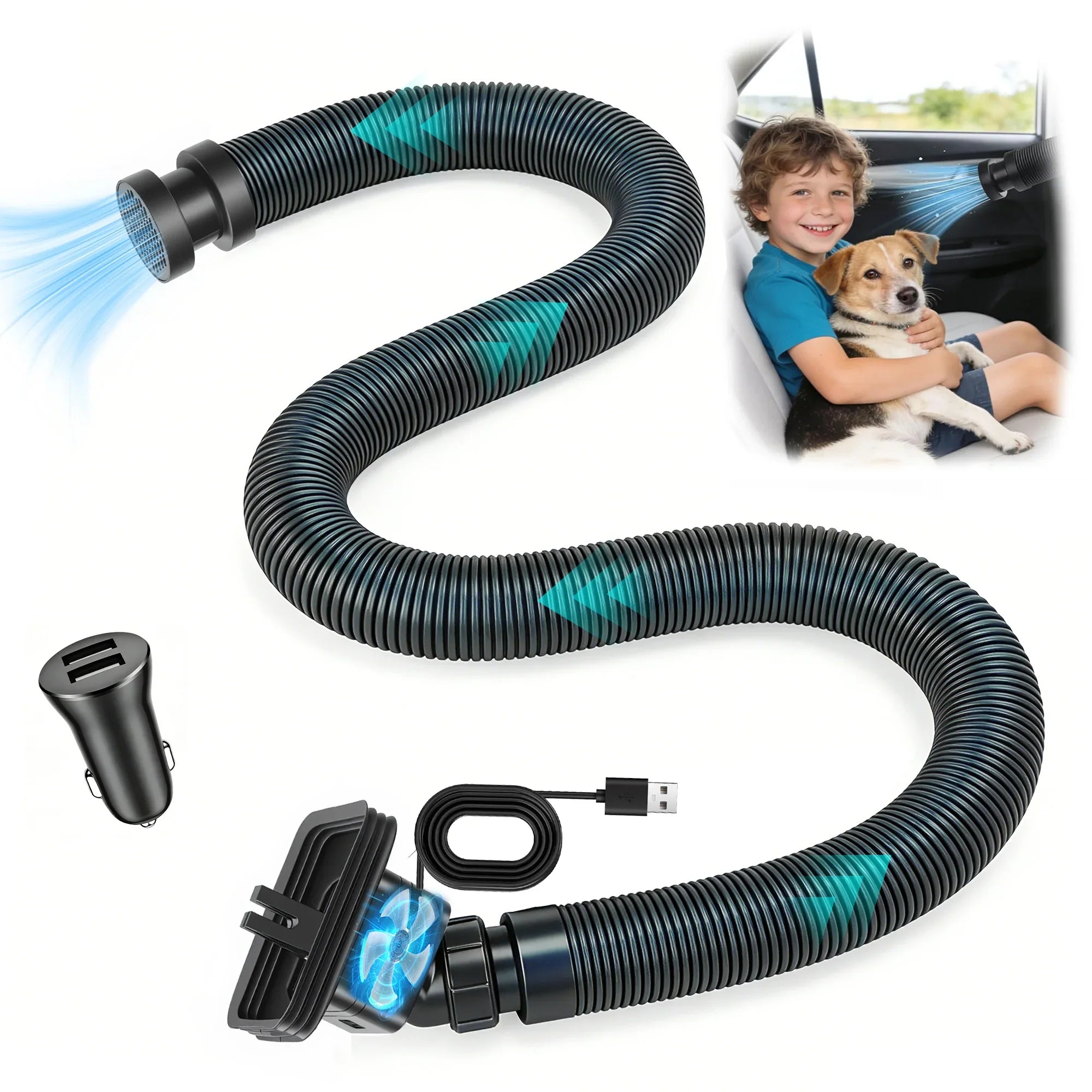
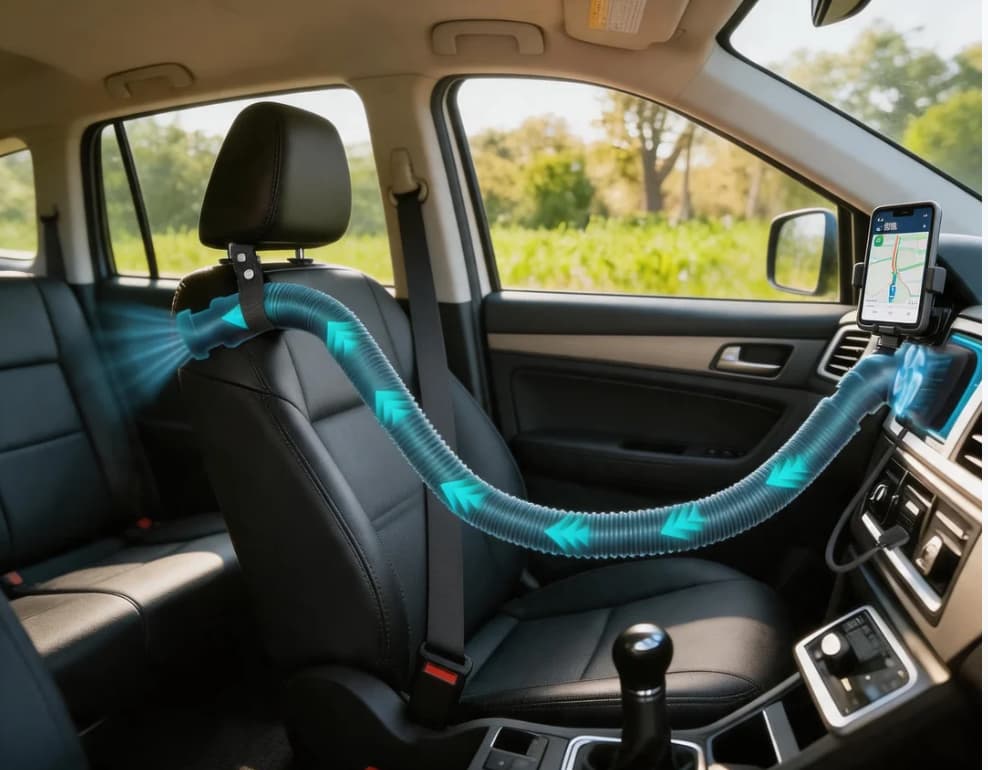
An AC vent extender is a flexible air duct that connects to a front dashboard vent. It carries conditioned air toward the back seat instead of allowing most of that airflow to remain in the front cabin.
This is particularly useful in cars without factory-installed rear AC vents.
Without an extender, drivers may lower the temperature or increase the blower speed because rear passengers are still hot. The front seats then become uncomfortably cold while the back remains warm.
An AC vent extender helps direct some of that existing cooled air to the area where it is needed.
It does not make the AC compressor itself more efficient. It optimizes air distribution instead of boosting AC cooling power.
If better air distribution lets you choose a warmer temperature or lower blower setting, it may reduce unnecessary climate-control energy use.
What a Rear Seat Fan Actually Does
A rear seat fan is normally powered through a USB port or 12V outlet. Depending on the design, it may attach to a headrest, sit on the center console, or use a flexible arm.
Unlike an AC vent extender, a fan does not carry cold air directly from the dashboard. It moves the air that is already inside the cabin.
The airflow can make passengers feel cooler by helping moisture evaporate from the skin. A fan can also spread conditioned air around the cabin after the AC has already lowered the temperature.
But can a car fan cool the back seat without AC?
A fan may improve comfort, but it cannot reduce cabin temperature or manufacture cold air. If the air inside the car is extremely hot, circulating that hot air will not solve the underlying problem.
Why Total AC Use Matters More Than Accessory Power
A small rear seat fan normally draws much less energy than the vehicle’s AC compressor.
For most drivers, there is no need to make complicated electrical calculations. Check the fan’s product label for its rated wattage or current.
For example, a USB fan labeled “5V, 1A” uses about 5 watts at maximum output. Actual consumption may be lower at reduced speeds.
By comparison, vehicle air conditioning has a much larger effect on fuel or battery consumption.
According to the U.S. Department of Energy and EPA’s fuel economy website, AC use can reduce the fuel economy of a conventional vehicle by more than 25% under very hot conditions, particularly on short trips. The percentage impact may be even greater for hybrids, plug-in hybrids, and electric vehicles.
That leads to a more practical question:
Is a rear seat fan more energy-efficient than car AC?
Yes—if mild conditions allow the fan to replace AC use. But when the weather is hot enough that AC is essential, an AC vent extender usually makes better use of the cold air the vehicle is already producing.
Where Each Option Falls Short
Neither accessory is a perfect solution. Understanding their limitations makes the comparison more balanced.
AC vent extender limitations
An AC vent extender depends entirely on the vehicle’s original AC system. It cannot produce airflow or cold air when the blower is switched off.
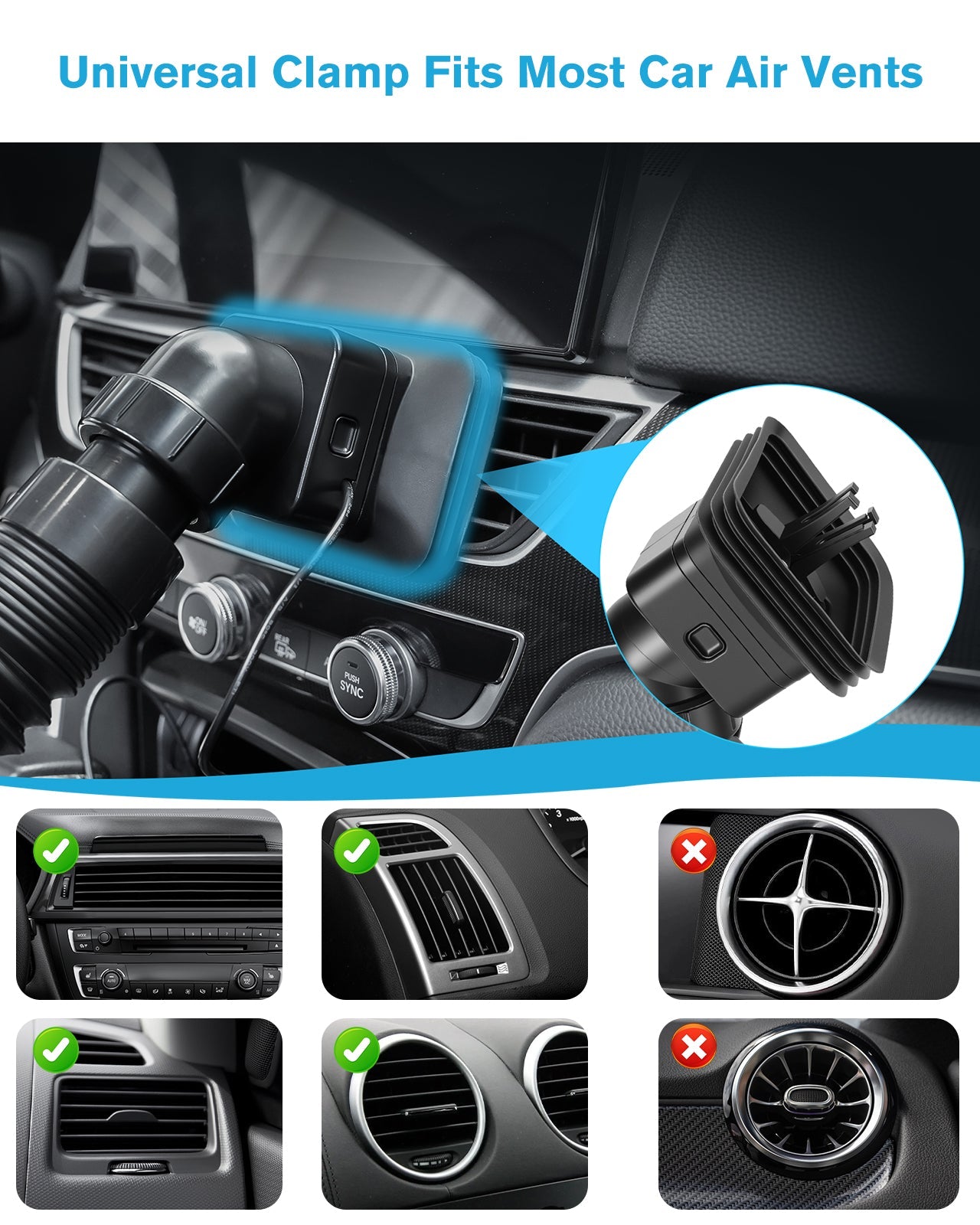
Compatibility can also be a problem. Some extenders may not fit:
- Round dashboard vents
- Motorized or electronically controlled vents
- Unusually small or recessed vents
- Fragile vent fins
- Vents with irregular shapes
A long, narrow, or sharply bent duct may restrict airflow. The front passenger may also notice weaker airflow because part of the conditioned air is being redirected toward the rear.
Before buying, check the vent shape and connection method carefully. Our guide to the 9 key things to consider before buying an AC vent extender covers vent compatibility, duct length, materials, and installation in more detail.
Rear seat fan limitations
The biggest weakness of a rear seat fan is simple: it moves air but does not create cold air.
In mild weather, that airflow may be enough. Inside a vehicle heated by direct summer sunlight, however, a fan alone may provide little meaningful relief.
Other possible drawbacks include:
- Fan noise at higher speeds
- Power cables around the center console or seats
- Mounts becoming loose on rough roads
- Limited airflow from small fan blades
- Battery drain if the outlet stays powered while parked
A fan is best viewed as a circulation accessory—not a replacement for AC in dangerously hot conditions.
Best Scenarios for an AC Vent Extender
The front seats feel cold while the rear seats remain hot
This is the clearest use case.
Instead of lowering the AC temperature for the entire vehicle, an AC vent extender sends some of the available cold air toward the rear passengers.
That more targeted airflow may help everyone become comfortable using a moderate climate-control setting.
Your vehicle has no factory rear vents
Compact cars and older vehicles may have strong front AC but poor rear-seat airflow.
If you are searching for the best way to cool rear seats in a car without rear vents, an AC vent extender is usually more effective than relying on natural cabin circulation.
You regularly carry children or rear-seat passengers
Rear-facing car seats can receive very little airflow from the dashboard vents. A securely installed extender can bring conditioned air closer to the rear seating area.
The outlet should not blow continuously at high speed directly into a child’s face. Tubes and attachments must also remain clear of airbags, seat belts, driver controls, and the driver’s view.
You drive in very hot or humid weather
When outside conditions already require AC, a fan alone may not be enough. Redirecting genuinely cooled air is normally more effective than circulating hot cabin air.
If the main problem in your vehicle is “cold front seats but a hot back seat,” you can explore the Forgyronis AC vent extender as a targeted cooling solution.
When a Rear Seat Fan Makes More Sense
The weather is warm rather than extremely hot
During an early morning, evening drive, or mild summer day, air movement may provide enough comfort without compressor-based cooling.
In that situation, the fan’s small electrical load can be much lower than the energy required to operate the AC.
The cabin has already been cooled
After the AC lowers the cabin temperature, a fan can help distribute the cool air. You may then be able to raise the temperature setting or reduce the vehicle blower speed.
Your dashboard vents cannot support an extender
A fan is often easier to install in a vehicle with round, motorized, recessed, or fragile vents.
Headrest-mounted models can also be moved between vehicles without modifying the dashboard.
Two passengers need separate airflow
Some dual-head fans allow each passenger to adjust the direction independently. This can be more flexible than a single duct outlet.
Which Option Is Better for an Electric Vehicle?
Cabin cooling draws energy from an EV’s high-voltage battery and can affect driving range. The best accessory depends on whether compressor-based cooling is necessary.
Choose an AC vent extender when:
- Strong AC is already required
- Rear passengers are not receiving enough conditioned air
- Better distribution may allow a warmer temperature setting
Choose a rear seat fan when:
- The weather is mild
- The cabin is already cool
- Air circulation can reduce or replace AC use
EV owners can also preserve range by pre-cooling the cabin while the vehicle is still connected to the charger.
Parking in the shade, using a windshield sunshade, and releasing trapped hot air before activating the AC can further reduce the initial cooling load.
Can You Use Both Accessories Together?
Yes. An AC vent extender and rear seat fan can complement each other, especially in a large SUV, minivan, or three-row vehicle.
A practical setup is:
- Open the doors or windows briefly to release trapped hot air.
- Start driving and activate the AC.
- Use the AC vent extender to carry cold air toward the rear.
- Run the rear seat fan at low speed to distribute that air.
- Reduce the vehicle blower speed once the cabin is comfortable.
This setup adds the small electrical load of the fan but may improve overall comfort in a large cabin.
For a compact car, using both may be unnecessary. Test the AC vent extender first and add a fan only if the conditioned air still does not circulate evenly.
Choosing Between These Car Cooling Accessories
Choose an AC vent extender if:
- Your car has strong front AC but no rear vents
- Rear passengers are consistently warmer than front passengers
- You live in a hot climate where AC is usually necessary
- You want quiet operation with no additional power consumption
- Your dashboard vents are compatible with the attachment
Look for a wide, smooth duct with secure connections. Avoid excessive length and sharp bends that may restrict airflow.
Choose a rear seat fan if:
- You want extra airflow without always using the AC
- Your cabin already has rear vents but needs better circulation
- You need adjustable airflow for two passengers
- Your dashboard vents cannot support an extender
- You want an accessory that can move between vehicles
Compare the fan’s power rating, speed settings, noise level, protective grille, cable length, and mounting stability.
Additional Ways to Reduce Summer Cooling Energy
The accessory you choose is only one part of efficient cabin cooling.
- Park in the shade whenever possible.
- Use a windshield sunshade.
- Open the doors or windows briefly before turning on the AC.
- Start driving instead of idling with the AC at maximum.
- Use recirculation after the hottest cabin air has escaped.
- Avoid setting the temperature lower than necessary.
- Replace a dirty cabin air filter.
- Use open windows at low speeds when conditions allow.
- Close the windows at highway speeds to reduce aerodynamic drag.
- Pre-cool an EV or plug-in hybrid while it is connected to external power.
Never leave a child, pet, or vulnerable passenger inside a parked vehicle. Neither an AC vent extender nor a portable fan can make a hot parked car safe.
Frequently Asked Questions
Does a rear seat fan cool the car without AC?
A rear seat fan moves cabin air and may make passengers feel cooler, but it does not actively reduce the air temperature. During extreme heat, it should be combined with proper ventilation or air conditioning.
Does an AC vent extender save fuel?
An AC vent extender does not automatically lower fuel consumption. It may save energy when improved rear-seat airflow allows you to use a warmer AC setting or lower blower speed.
Is an AC vent extender better than a car fan for a baby?
An AC vent extender usually delivers conditioned air to a rear-facing car seat more effectively. Use gentle airflow and avoid directing high-speed cold air continuously at the baby’s face.
All ducts, fan mounts, and cables must be secured outside the child’s reach.
Will vent extenders reduce airflow for front passengers?
Yes. An AC vent extender redirects part of the airflow from a front vent, so the person sitting near that vent may notice reduced airflow.
A properly sized, well-sealed duct minimizes unnecessary restriction. If the front passenger still needs direct air, attach the extender to a less important vent or use a lower-resistance design.
Can I install both an AC vent extender and rear seat fan in an SUV?
Yes. This combination can work well in an SUV or other large vehicle.
The AC vent extender carries conditioned air toward the rear, while a low-speed fan distributes it across a wider seating area. Make sure both accessories are securely mounted and do not interfere with airbags or visibility.
Can an AC vent extender work without air conditioning?
It can carry uncooled ventilation air when the blower is running, but it cannot work independently or produce its own airflow. Its cooling performance depends on the vehicle’s AC system.
Can a rear seat fan drain the car battery?
A small fan normally has a low power draw while the vehicle is operating. However, it may discharge the 12V battery if left running for an extended period after the car is switched off.
Check whether your USB or 12V outlet remains powered while the vehicle is parked.
Which accessory is better for EV range?
Use an AC vent extender when AC is already necessary and a fan when air movement can reduce or replace compressor use. The better choice is the one that lowers the total demand on the climate-control system.
Final Verdict
In a direct AC extender vs car fan energy comparison, the AC vent extender wins because it requires no electrical power of its own.
For total vehicle energy use, the answer depends on the weather:
- Hot climate with frequent rear passengers: Choose an AC vent extender.
- Mild weather where airflow may replace AC: Choose a rear seat fan.
- Large SUV with uneven cooling: Consider using both.
- Maximum EV range or fuel savings: Choose the option that safely reduces compressor use.
An AC vent extender is generally the better solution when the vehicle is already producing cold air but struggling to deliver it to the rear seats. A fan is more useful when the cabin needs circulation rather than additional cooling.
If targeted rear-seat cooling matches your situation, view the Forgyronis AC vent extender. Before purchasing, you can also review our 9 key AC vent extender buying considerations to confirm that it fits your vehicle.
Fact-check source: Fuel Economy in Hot Weather — U.S. Department of Energy and EPA